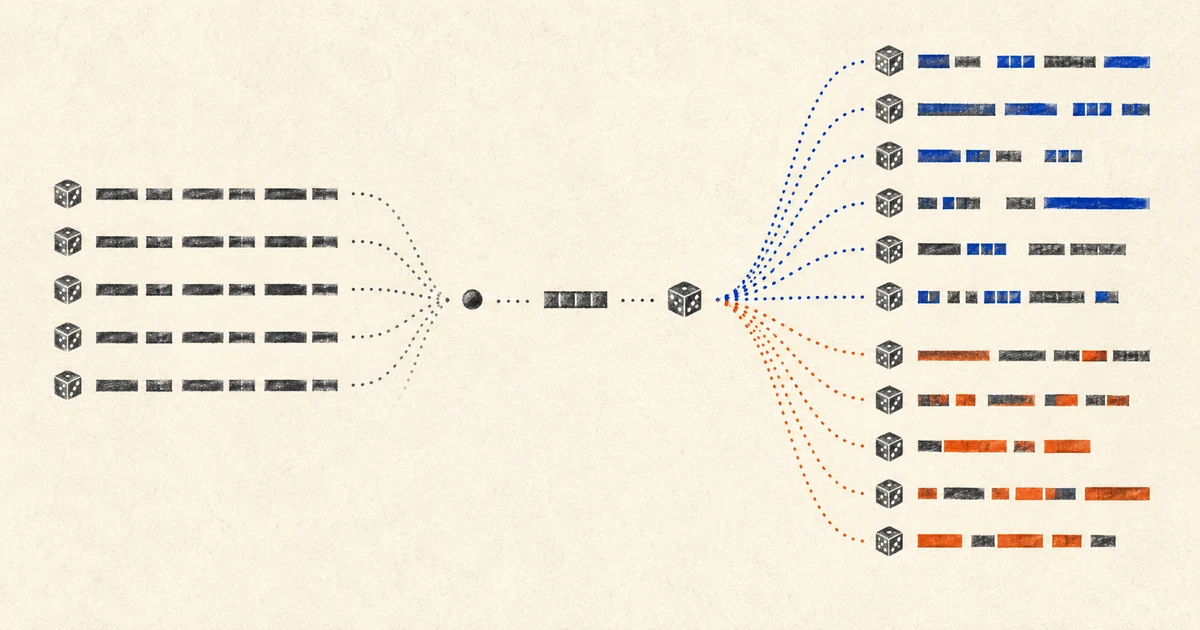
Lenny’s Newsletter recently ran a post on making better designs with AI. One of the most interesting techniques came from Sakana AI’s SSoT paper: ask a model to generate a starting seed, then derive its response from that seed.
It’s a simple trick that could be useful for juicing more “creativity” from models. I also wanted to try directly injecting a UUID, as if asking a model to generate randomness wasn’t random enough. A friend wondered whether turning up the temperature would accomplish the same thing, so I compared all three approaches.
The experiment
I tested plain prompting, SSoT, and supplied UUIDs at temperatures 0, 0.5, 1, and 1.5. The models were GPT-5.6 Sol, Gemini 3.8 Flash, DeepSeek V4 Flash, and Qwen 3.5 9B.
The Sakana paper uses coin flips and dice rolls. I added creative tasks, including naming a product, to see how the techniques affected those generations. There were 24 attempts per condition and 4,608 trials in total, costing about $3.12.
Product names
Temperature reduced name repetition substantially for DeepSeek and Qwen. SSoT helped Sol and Gemini more, where temperature alone did less. At temperature 1, Sol’s repetition was 76% with plain prompting, 1% with SSoT, and 11% with a UUID.
Repetition here means the share of answer pairs containing the same name. It measures variety, not whether the names were good.
Swipe to compare models
Sol
Gemini
DeepSeek
Qwen 9B
24 attempts per condition. Points with fewer than five usable answers are omitted.
Dice rolls
More varied outputs didn’t necessarily mean fair sampling. Plain prompting remained heavily concentrated: Sol returned 4 in all 96 original plain rolls, across every temperature.
At temperature 1.5, the original tagged prompt still produced 60 fours in 60 rolls. Removing the tag instruction changed that to 56 in 60; a simpler prompt produced 51 in 60. Temperature can dislodge the favorite, but the prompt affects how strong that favorite is.
Swipe to compare models
Sol
Gemini
DeepSeek
Qwen 9B
24 attempts per condition. Points with fewer than five usable answers are omitted.
Takeaway
Seed prompting helped most where temperature alone wasn’t enough. For Sol and Gemini’s names, SSoT added substantial variety. For DeepSeek, temperature already did much of the work.
I’d treat seed prompting and temperature as complementary controls, not substitutes. These were small, short-context tests that measured repetition and sampling bias, not creative quality. Different wording isn’t necessarily a different idea.